Publication Alert
Abundantly Clear: Intact Grassland Cores Host More Grassland Birds
Recent research highlights that growing or stable populations of grassland bird species are found in intact grassland cores while population declines mirror spatial patters in woody plant expansion and land-use conversion.

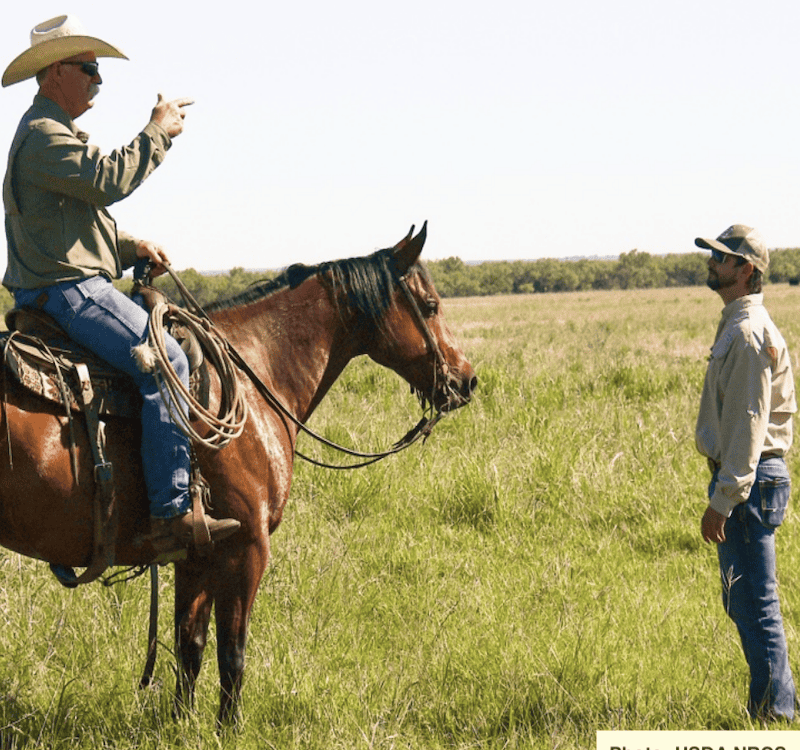
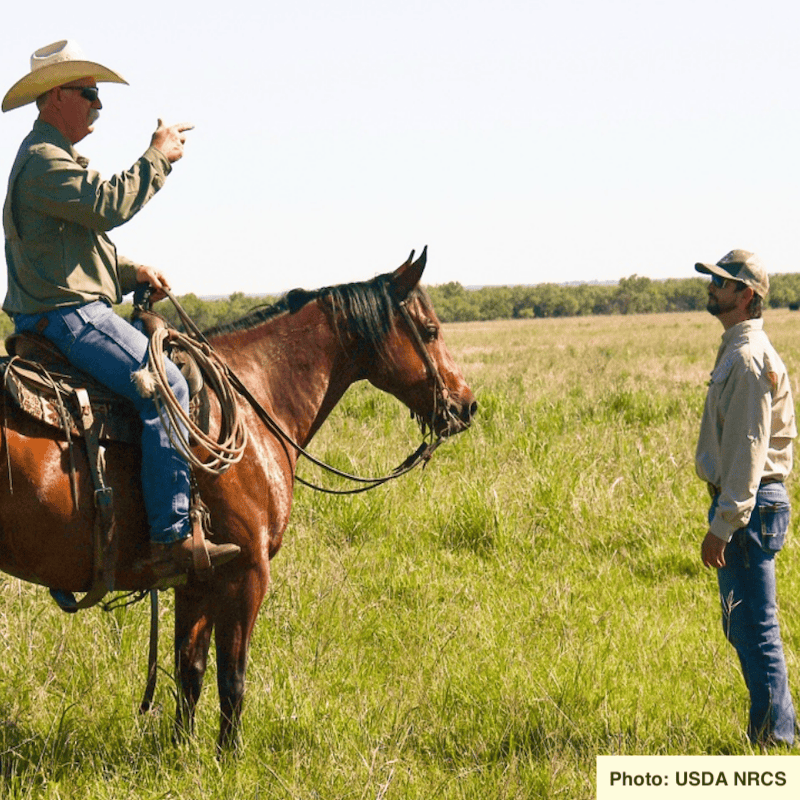
Double C Cattle Company Reclaims Oklahoma’s Prairie With Prescribed Fire
August 18, 2026
Where There’s Water, There’s Life
September 10, 2026
Is it time for a Great Plains Grasslands Conservation Design?
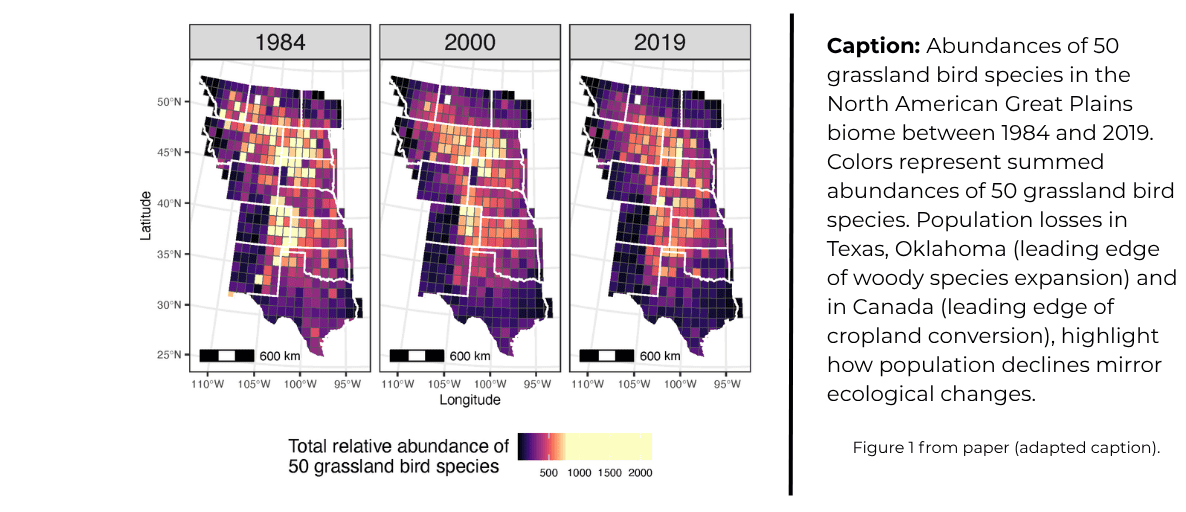
Across the Great Plains grasslands, bird species are declining. In fact, of all terrestrial guilds, grassland birds have suffered some of the most dramatic declines in the past 50 years.
New research from Caleb Roberts a researcher with the U.S. Geological Survey, Arkansas Cooperative Fish & Wildlife Research Unit, examined how these losses are clustered spatially and by species, while also exploring where bird populations have increased or remained stable.
The team used data from the North American Breeding Bird Survey (BBS) from 1984-2019 to characterize spatiotemporal changes in population abundance for 50 grassland bird species found in the Great Plains.
Their findings show that growing or stable populations are clustered in intact grassland cores where woody expansion and crop conversion have not fragmented the open, grassland habitats that grassland-obligate species require. Conversely, areas where grassland bird populations are declining are clustered on the leading edges of woody expansion and cropland conversion.
They found that across all 50 species, abundance generally declined, but in some core areas, specifically the central Plains, abundance remained stable. Population losses were mostly clustered along the southeastern edge of the Plains, the same geography where woody expansion is most acute.
These findings align with a “Defend the Core” strategy that prioritizes proactive maintenance of intact grasslands over reactive conservation in already degraded areas.
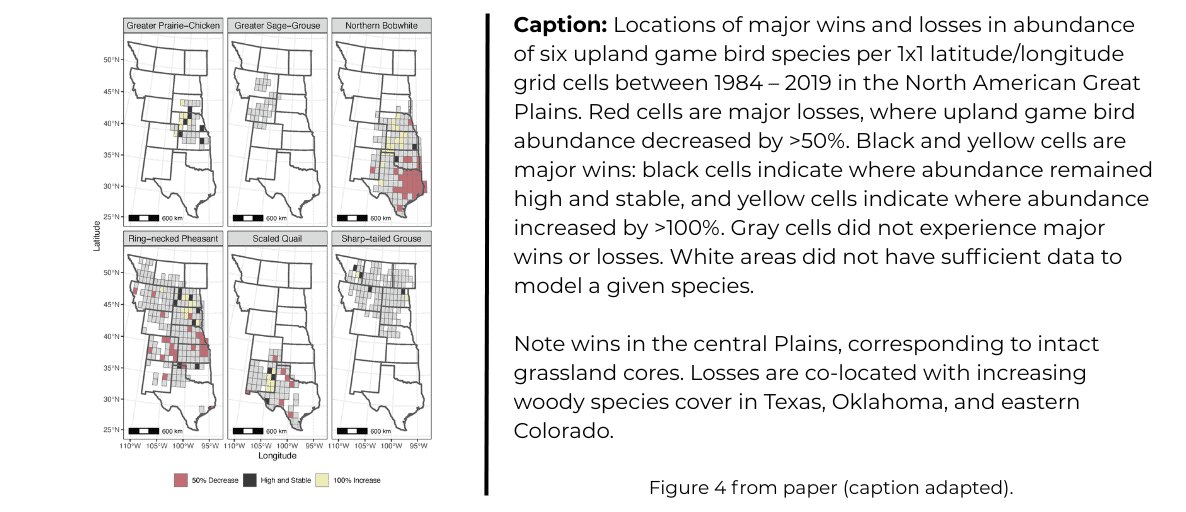
Areas where population abundance increased were less spatially clustered than population losses. Two specific areas – eastern New Mexico and western Nebraska – showed population wins for scaled quail and greater prairie-chickens respectively. In New Mexico, local, long-running lesser prairie-chicken conservation efforts overlap the population wins for scaled quail (lesser prairie-chickens were not part of the study due to a lack of data in the BBS for the species). And in western Nebraska, the Sandhills Task Force and the Loess Canyons Rangelands Alliance have spent decades battling woody encroachment. In fact, the Loess Canyons Rangeland Alliance accomplished the first recorded instance of humans reversing the impacts of woody plant encroachment on grassland birds at the ecoregion scale.
Overall, the researchers draw three main conclusions from their findings:
- The Great Plains still has functional ecological cores. Prioritizing intact grasslands cores for proactive conservation is more effective and efficient than disparate, disconnected conservation efforts in areas that are already degraded.
- Protecting and expanding these grassland cores from woody species and land use conversion provides the best opportunity for protecting all grassland bird species. While focal species can serve as a litmus test for conservation efficacy, conservation that focuses on overall grassland ecological integrity will produce better results for birds and other species that rely on grasslands.
- Conservationists and landowners can come together to create a shared vision for productive grasslands that support livestock production while supporting grassland birds. Livestock production is the predominant land use in this region. Woody species expansion and land use conversion impact producers through loss of forage and available rangeland. These same drivers reduce bird populations.
They also argue that their findings position the conservation community to create a Great Plains Grasslands Conservation Design, modeled on the Sagebrush Conservation Design, that identifies intact grassland cores, ranks and evaluates drivers of ecological change, and helps better prioritize grassland conservation across the Plains.
Empowering landowners through voluntary, incentive-based conservation efforts that focus on the primary drivers of ecological change (woody species and land-use conversion) is the same approach articulated in WLFW’s Framework for Conservation Action in the Great Plains Grasslands Biome.
This research shows that this approach, combined with a spatially explicit Great Plains Grasslands Conservation Design, provides the best chance for maintaining and, ultimately, improving the ecological integrity of the Great Plains grasslands.
BIOME-SCALE SPATIAL PATTERNS OF AVIAN ABUNDANCE REVEAL PROACTIVE CONSERVATION OPPORTUNITIES IN NORTH AMERICAN GRASSLANDS
Abstract: North American grassland birds have experienced steeper population declines than any other avian guild, yet conservation efforts remain largely reactive and fragmented. We used nearly four decades of North American Breeding Bird Survey data to identify biome-scale spatial patterns (clustering) of grassland bird abundance for the Great Plains. Our results reveal an ecological core in the north-central Plains where community-level abundance is either increasing by >100% or remains high and stable, providing a strategic roadmap for a “Defend the Core” conservation approach. This approach flips the script from reactive triage centered on isolated population fragments to a proactive strategy of maintaining large-scale ecosystem integrity. Conversely, we found that population losses are more spatially clustered than wins, reflecting the relentless, one-way movement of woody encroachment and agricultural conversion. This asymmetry supports prioritizing intact landscapes, as current restoration rates are often outpaced by the scale of habitat loss. Notably, we found that community-level spatial clustering is a more robust indicator of biome condition than trends of individual flagship species, suggesting that managing for ecosystem integrity provides a more effective multi-species umbrella. Given our results, there is an opportunity for operationalizing a Great Plains Conservation Design that is ecosystem-centric and rooted in the sustainability of the private-land cattle production that maintains these open spaces. By leveraging avian abundance as a biological sensor, managers and producers can deploy a shared vision that matches the spatial scale of the threats, moving from reactive triage to proactive defense of core working grasslands in North America.
Citation: Caleb P. Roberts, Victoria M. Donovan, Samantha M. Cady, Brandon P.M. Edwards, Scott Morford, David Naugle, Rheinhardt Scholtz, Dirac Twidwell, Daniel R. Uden, Dillon Fogarty, “Biome-scale spatial patterns of avian abundance reveal proactive conservation opportunities in North American grasslands,” Biological Conservation, Volume 322, 2026.
Acknowledgements: Funding was provided by Arkansas Game and Fish Commission through cooperative agreement 1434-04HQRU1567 and by the University of Arkansas Department of Biological Sciences. Any use of trade, firm or product names is for descriptive purposes only and does not imply endorsement by the U.S. Government.
Permanent URL: https://doi.org/10.1016/j.biocon.2026.112055