Robb, B. S., Shapiro, J., Smith, K., Cole, E. K., Courtemanch, A. B., Dewey, S. R., Kauffman, M. J., Middleton, A. D., Mong, T. W., & Merkle, J. A. (2026). Space between houses influences movement and habitat selection of ungulates: Width as a novel metric of development. Journal of Applied Ecology, 63, e70395.
Abstract
Wildlife often lose access to habitat due to housing development. The magnitude of indirect habitat loss can be conditional on the configuration of individual houses, but commonly used metrics (i.e. density or distance) can overlook the configuration of development.
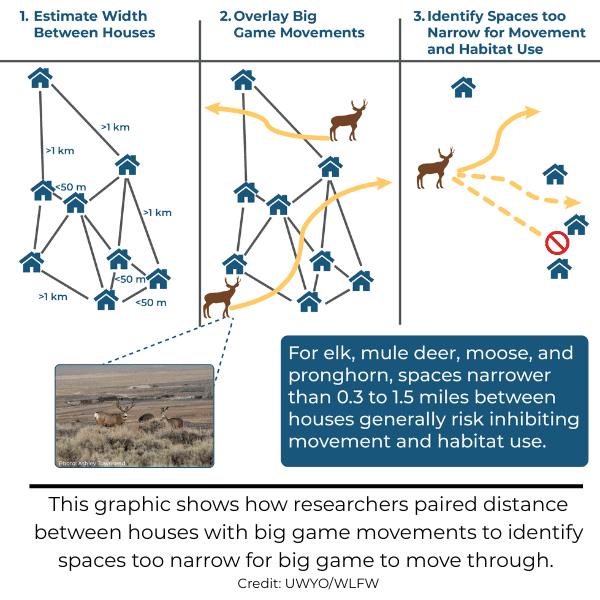
We introduce a novel framework to index the configuration of development based on the width of space between houses and associated structures. We use resource selection functions to assess the degree that GPS-collared elk (Cervus canadensis), mule deer (Odocoileus hemionus), pronghorn (Antilocapra americana), and moose (Alces alces) on winter range and on migration routes use space between houses within northwest Wyoming, USA, near the towns of Cody and Jackson. Further, to help inform regulations aiming to promote wildlife movement across a gradient of land uses, we differentiated between individuals residing in primarily rural and exurban areas.
Rural populations of elk, mule deer, pronghorn and moose avoided spaces narrower than 2 km and never used spaces narrower than 50 m between houses, whereas exurban populations of elk, mule deer and moose selected for spaces narrower than 2 km but avoided spaces narrower than 50 m. We identified cutoffs in rural and exurban areas where space may become too narrow for most animals to use.
Through this metric, managers and policy makers can inform the necessary width to maintain wildlife movement through corridors. Our width metric can be applied to other systems, and our workflow is publicly available (https:// wildlifemovetools.org/width-calculator) so users can estimate the width of space between structures in their focal areas.