Caleb P. Roberts, Victoria M. Donovan, Samantha M. Cady, Brandon P.M. Edwards, Scott Morford, David Naugle, Rheinhardt Scholtz, Dirac Twidwell, Daniel R. Uden, Dillon Fogarty, “Biome-scale spatial patterns of avian abundance reveal proactive conservation opportunities in North American grasslands,” Biological Conservation, Volume 322, 2026.
Abstract
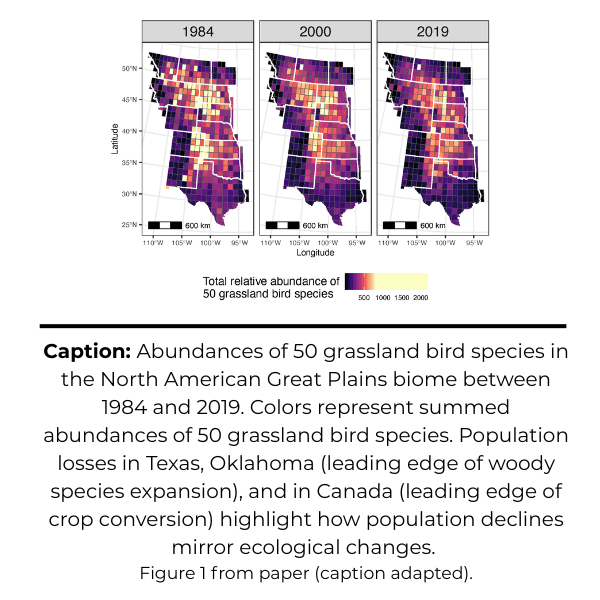
North American grassland birds have experienced steeper population declines than any other avian guild, yet conservation efforts remain largely reactive and fragmented. We used nearly four decades of North American Breeding Bird Survey data to identify biome-scale spatial patterns (clustering) of grassland bird abundance for the Great Plains. Our results reveal an ecological core in the north-central Plains where community-level abundance is either increasing by >100% or remains high and stable, providing a strategic roadmap for a “Defend the Core” conservation approach. This approach flips the script from reactive triage centered on isolated population fragments to a proactive strategy of maintaining large-scale ecosystem integrity. Conversely, we found that population losses are more spatially clustered than wins, reflecting the relentless, one-way movement of woody encroachment and agricultural conversion. This asymmetry supports prioritizing intact landscapes, as current restoration rates are often outpaced by the scale of habitat loss. Notably, we found that community-level spatial clustering is a more robust indicator of biome condition than trends of individual flagship species, suggesting that managing for ecosystem integrity provides a more effective multi-species umbrella. Given our results, there is an opportunity for operationalizing a Great Plains Conservation Design that is ecosystem-centric and rooted in the sustainability of the private-land cattle production that maintains these open spaces. By leveraging avian abundance as a biological sensor, managers and producers can deploy a shared vision that matches the spatial scale of the threats, moving from reactive triage to proactive defense of core working grasslands in North America.