Publication Alert
Where There’s Width, There’s A Way (For Big Game To Move)
WLFW-affiliated research from Wyoming informs how residential development in the West can balance housing growth with the movement needs of migrating big game.

Data-Driven Wildfire Recovery in the Great Plains
April 29, 2026
Migratory Big Game Framework In Focus: Wildlife Conservation Through Sustainable Ranching
June 2, 2026
NEW RESEARCH CHARTS A PATH TO REDUCE IMPACTS OF RESIDENTIAL DEVELOPMENT ON MIGRATORY BIG GAME
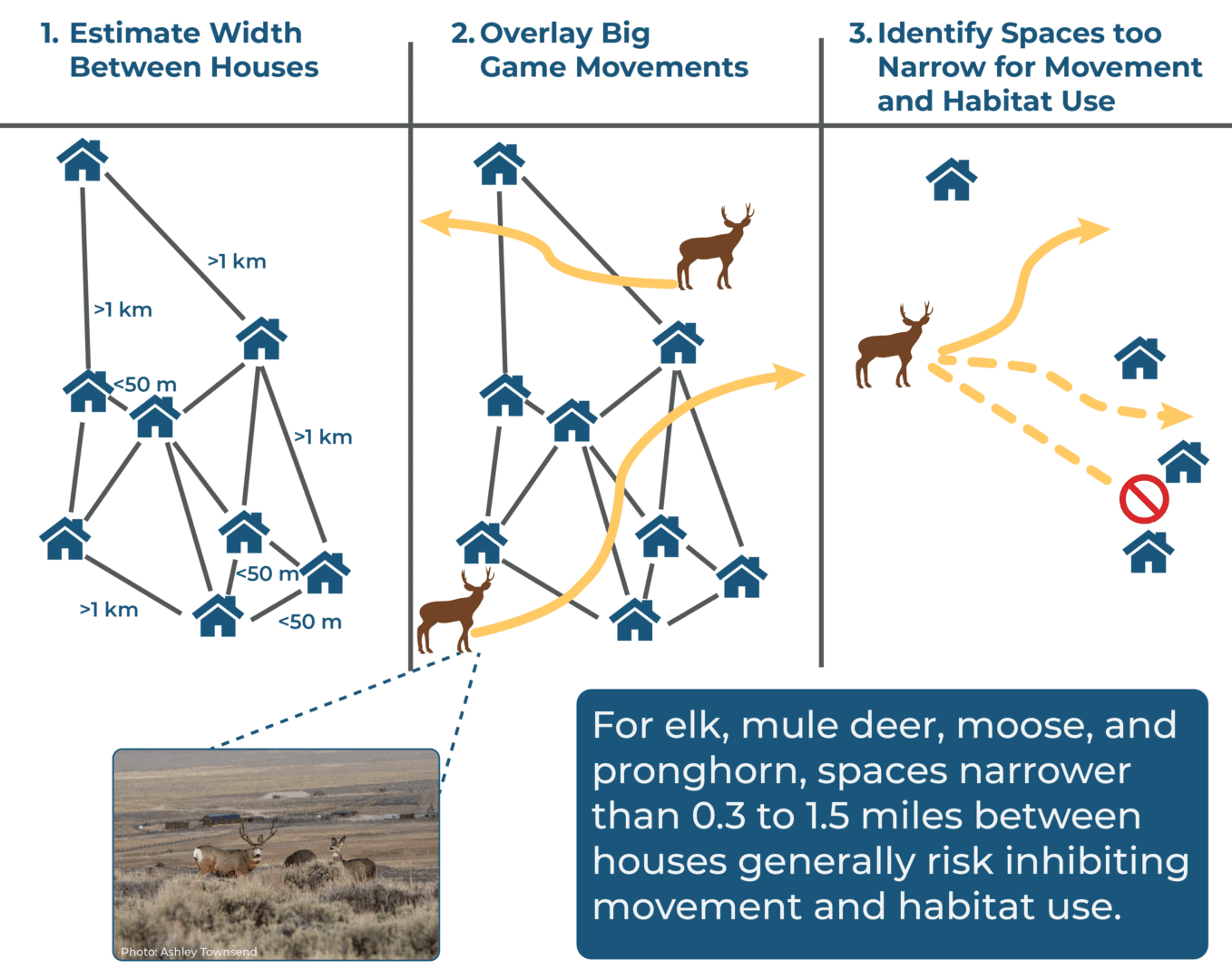
For the West’s big game – elk, mule deer, pronghorn, and moose – there are few threats as impactful as residential development in previously undeveloped landscapes. As housing spreads into typically open, working rangelands which support migrating big game and other sagebrush-associated wildlife, these species face not only the direct loss of habitat from the building footprint, but also the indirect loss of habitat by avoiding spaces surrounding development.
Without clear guidance on how much open space must be maintained between homes, new housing development, especially in rural areas, risks constraining animals into narrow bottlenecks, threatening to cutoff movement and habitat use entirely.
New WLFW-supported research led by Jerod Merkle, WLFW’s Migratory Big Game science advisor and associate professor at the University of Wyoming, takes a novel approach to looking at how houses impact big game.
Merkle and his team measured the space, or width, between houses, defining “width” as the shortest distance of open space (i.e., undeveloped land) between any two nearby houses or associated structures. Then, they paired those distance measurements with the movements of mule deer, elk, pronghorn, and moose across housing contexts (rural and semi-urban areas) in and around Cody and Jackson, Wyoming.
Broadly, they found that big game species were less likely to use narrow spaces between houses and more likely to move through as those spaces widened, with some exceptions in semi-urban contexts. However, they found that the specific distances at which animals shifted from avoiding to tolerating housing varied by species, study area, and whether individuals spent their time in rural or semi-urban areas.
When they summarized findings across all species and contexts, the team found clear evidence of indirect habitat loss between houses. Some big game avoided habitats between houses that were a mile or two apart, while others were still willing to move through spaces as narrow as a quarter to half a mile between houses.
“Our goal for this work is to help make recommendations that can promote science-informed development guidelines that meet the demand for new houses while also maintaining big game habitat and movement,” explains Dr. Merkle. “Our research helps provide the numbers behind the general and well accepted rule-of-thumb that clustering houses and leaving larger, contiguous areas of open space between those clusters is best for the West’s iconic wildlife.”
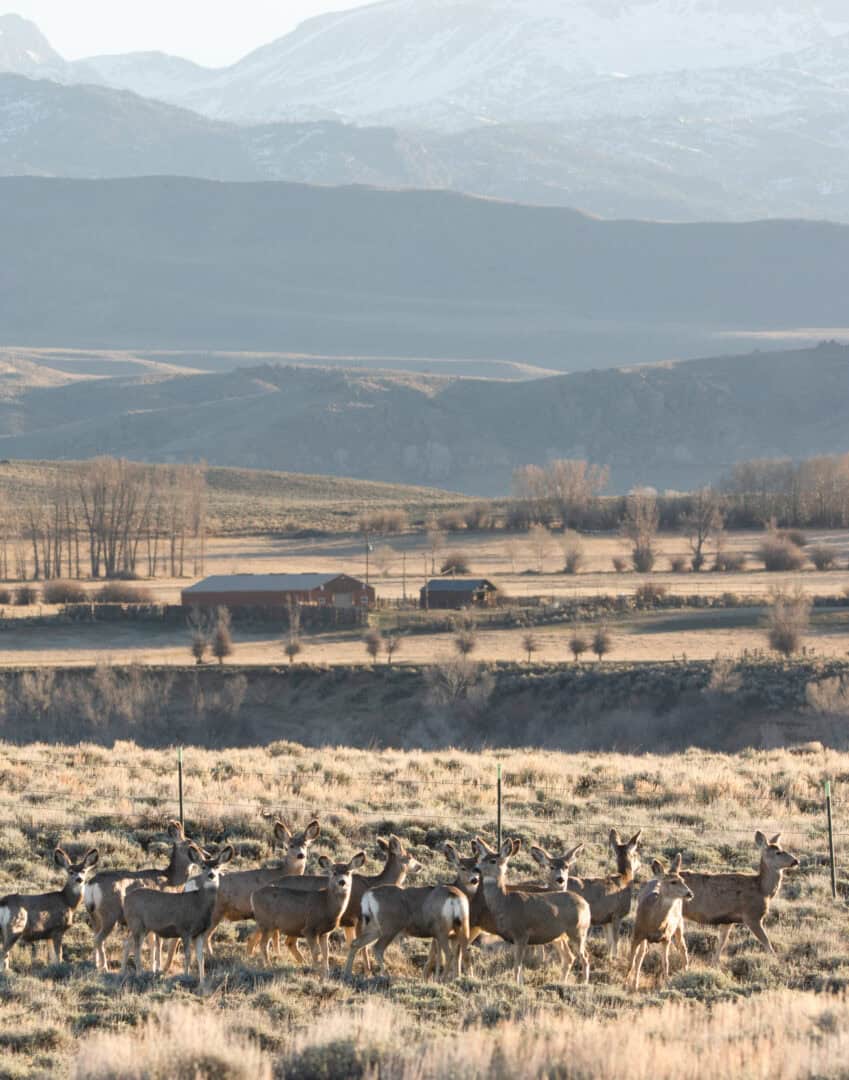
For example, if a landscape was subdivided into 35-acre parcels and each house was built in the middle of each parcel, the minimum width would be about one-quarter of a mile. Based on the team’s findings, this area would be strongly avoided by rural elk, mule deer, pronghorn, and moose. However, strategic placement of each house within its respective parcel could increase this average width to nearly two-thirds of a mile, which would be more accessible (albeit still moderately avoided) for rural elk, mule deer, pronghorn and moose.
The width metric is analogous to defining bottlenecks in wildlife corridor conservation and planning, where topography or other impermeable features restrict movement into a narrow space. When combined with wildlife movement data, width as a metric of development can help identify locations that are on the verge of being too narrow for big game and/or locations where further development would risk cutting off big game movements altogether, due to either lack of space or associated surrounding disturbances (e.g., human activity, fences, etc.).
In the example above, if the subdivided landscape was located between other open and accessible habitats, configuring housing to provide an average width of two-thirds of a mile would likely allow wildlife to travel between the larger, adjacent landscapes and use that habitat (i.e., feed or rest) normally. Configuring houses with a one-quarter-of-a-mile average width would largely prevent wildlife from accessing the adjacent habitat.
To help put this new metric into practice, the team translated the results into a publicly accessible tool (wildlifemovetools.org/width-calculator) where users can assess the configurations of housing development that maintains enough space for migratory big game to access habitats.
This research was made possible by a collaboration between University of Wyoming, Wyoming Game and Fish Department, U.S. National Park Service, U.S. Fish and Wildlife Service, U.S. Geological Survey, and University of California Berkeley.
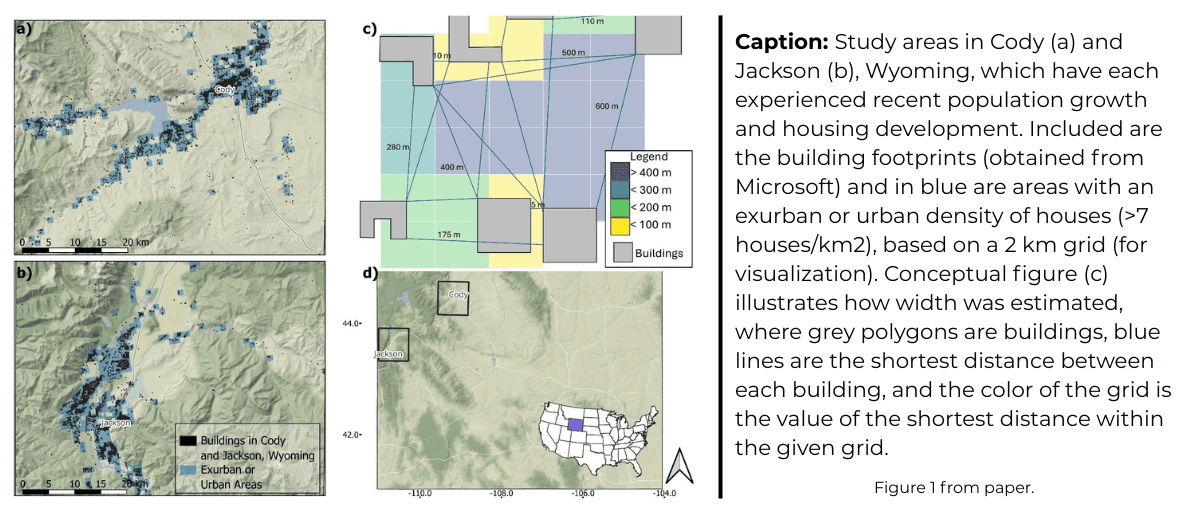
SPACE BETWEEN HOUSES INFLUENCES MOVEMENT AND HABITAT SELECTION OF UNGULATES: WIDTH AS A NOVEL METRIC OF DEVELOPMENT
Abstract: Wildlife often lose access to habitat due to housing development. The magnitude of indirect habitat loss can be conditional on the configuration of individual houses, but commonly used metrics (i.e. density or distance) can overlook the configuration of development.
We introduce a novel framework to index the configuration of development based on the width of space between houses and associated structures. We use resource selection functions to assess the degree that GPS-collared elk (Cervus canadensis), mule deer (Odocoileus hemionus), pronghorn (Antilocapra americana), and moose (Alces alces) on winter range and on migration routes use space between houses within northwest Wyoming, USA, near the towns of Cody and Jackson. Further, to help inform regulations aiming to promote wildlife movement across a gradient of land uses, we differentiated between individuals residing in primarily rural and exurban areas.
Rural populations of elk, mule deer, pronghorn and moose avoided spaces narrower than 2 km and never used spaces narrower than 50 m between houses, whereas exurban populations of elk, mule deer and moose selected for spaces narrower than 2 km but avoided spaces narrower than 50 m. We identified cutoffs in rural and exurban areas where space may become too narrow for most animals to use.
Through this metric, managers and policy makers can inform the necessary width to maintain wildlife movement through corridors. Our width metric can be applied to other systems, and our workflow is publicly available (https:// wildlifemovetools.org/width-calculator) so users can estimate the width of space between structures in their focal areas.
Citation: Robb, B. S., Shapiro, J., Smith, K., Cole, E. K., Courtemanch, A. B., Dewey, S. R., Kauffman, M. J., Middleton, A. D., Mong, T. W., & Merkle, J. A. (2026). Space between houses influences movement and habitat selection of ungulates: Width as a novel metric of development. Journal of Applied Ecology, 63, e70395.
Permanent URL: https://doi.org/10.1111/1365-2664.70395
Acknowledgements: H. Sawyer (Western EcoSystems Technology, Inc.), L. Olson (Wyoming Game and Fish Department), L. E. Hall (Wyoming Game and Fish Department), C. Riginos (The Nature Conservancy), K. Krasnow (Jackson Hole Alliance), M. Graham (Teton Conservation District) contributed GPS collar data. We thank M. Smith for the helpful discussions and helping motivate this study. We thank Matthew Struebig and two anonymous reviewers for their thoughtful comments on earlier versions of this manuscript. This work was supported by Knobloch Family Foundation, Wyoming Migration Initiative, Beyond Yellowstone Living Lab, and Natural Resources Conservation Service. Any use of trade, firm, or product names is for descriptive purposes only and does not imply endorsement by the U.S. Government.