
Science Webinars
Our Science to Solutions: For Western Working Lands Seminar Series delivers the latest WLFW science and conservation solutions in an hour-long format. Catch them live or watch on demand below.
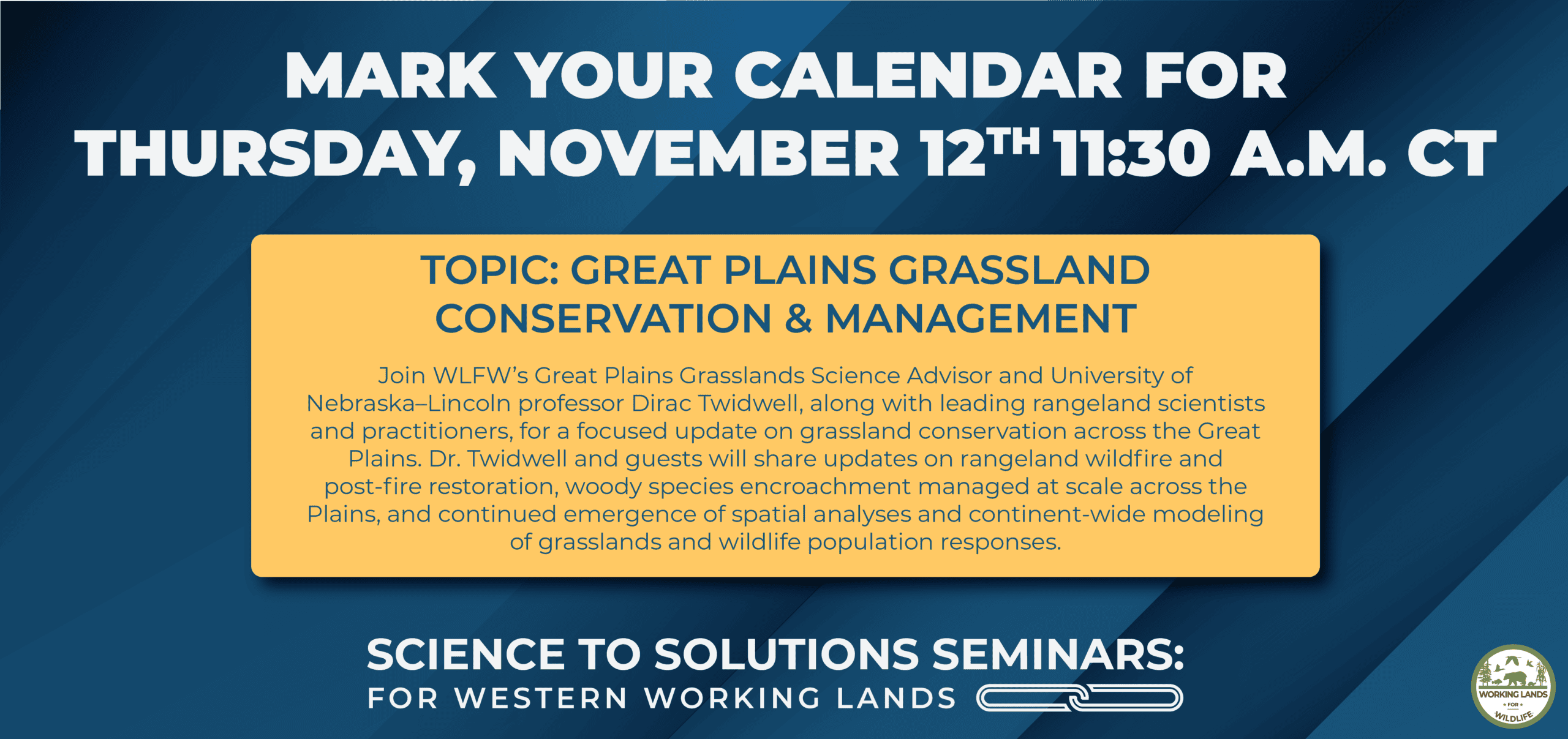
Seminar Description: Join WLFW’s Great Plains Grasslands Science Advisor and University of Nebraska–Lincoln professor Dirac Twidwell, researcher Samantha Cady, and Flint Hills Initiative Director, Tony Capizzo, for a focused update on grassland conservation across the Great Plains. They will share updates on rangeland wildfire and post-fire restoration, woody species encroachment managed at scale across the Plains, and the continued emergence of spatial analyses and continent-wide modeling of grasslands and wildlife population responses.
Presenters: Dirac Twidwell, Samantha Cady, and Tony Capizzo
Dirac Twidwell is a Professor and Rangeland Ecologist at the University of Nebraska. His work emphasizes how grasslands contribute to human well-being, and how simple ecological transitions away from grasslands are leading to increased wildfire disasters, losses in livestock production and rancher income, declines in grassland-dependent wildlife, and negative impacts to social programs – like loss of revenue for public education. His program focuses on partnering with landowner networks across multiple states in the Great Plains to advance solutions to the most challenging issues in rangelands.
Dr. Twidwell also serves in unique roles to facilitate science adoption into regional and national grassland conservation efforts. He serves as a National Science Advisor for the USDA NRCS and Working Lands for Wildlife, a Science Expert for the Central Grasslands Roadmap, and an Advisory Board Member of the Great Plains Fire Science Exchange.
Samantha Cady is a researcher in the Twidwell Lab at the University of Nebraska-Lincoln where she studies top drivers of grassland loss to inform and improve conservation delivery across the Great Plains.
Anthony Capizzo works for the Kansas chapter of The Nature Conservancy managing the Flint Hills Initiative, which aims to protect Flint Hills prairie biodiversity through supporting working lands and community-based conservation. Tony has been with The Nature Conservancy for the past 14 years after receiving a BS in Conservation Biology from the University of Michigan.
Seminar Description: Mesic resources including wet meadows, springs, seeps, and riparian corridors are among the most valuable and vulnerable habitats across the Sagebrush Biome. This Science to Solutions Seminar will introduce the Mesic Analysis Platform, a Working Lands for Wildlife app designed to help conservation practitioners identify, prioritize, and monitor restoration opportunities where water matters most. Participants will receive an overview of the platform's capabilities and learn how it supports science-based, landscape-scale conservation planning and on-the-ground implementation.
Presenters: Jeremy Maestas, Kris Mueller, and Derek Tilley
Jeremy Maestas is an ecologist with the USDA-NRCS West National Technology Support Center based in Bend, Oregon, where he provides technical leadership for USDA’s Working Lands for Wildlife efforts. His work focuses on improving the resilience of America’s working rangelands by reducing large scale threats, such as, conifer encroachment, annual grass invasion, and riparian and wet meadow degradation. He is nationally recognized for translating emerging science into practice, including a national training campaign to accelerate adoption of low-tech, process-based approaches for riparian and wet meadow restoration.
Kris Mueller specializes in GIS and cartographic design, helping WLFW create meaningful, intuitive maps that bridge the gap between science and on-the-ground conservation. He received a B.S. in Forestry/Environmental Science from Iowa State University in 2019, followed by the University of Montana's (UM) GIS certificate program in 2022 and an M.S. in Systems Ecology from UM in 2025, where his thesis project focused on creating the Mesic Analysis Platform. When not making maps of western landscapes, he likes to explore them with his partner and dog by gravel biking, hiking, XC skiing, and snowboarding.
Derek Tilley, PhD., is the Sagebrush Technology Transfer Specialist with the Working Lands For Wildlife team at the University of Montana. His work focuses on the proactive conservation and restoration of sagebrush ecosystems, with an emphasis on addressing invasive annual grasses, woodland expansion, and mesic resource degradation. He previously spent more than 20 years with the USDA Natural Resources Conservation Service’s Aberdeen Plant Materials Center.
Seminar Description: Conifer encroachment is one of the leading drivers of rangeland degradation and ecosystem change across western working lands. This Science to Solutions Seminar explores the ecological impacts of conifer expansion in the sagebrush biome and the science-informed conservation strategies Working Lands for Wildlife promotes. Participants also receive an overview of available planning tools, resources, and partnership opportunities that support proactive, landscape-scale conservation and on-the-ground implementation.
Presenters: Shea Coons and Derek Tilley
Shea Coons is the Outreach Scientist for Working Lands for Wildlife where she translates science into on-the-ground applications. Her work centers on preserving Montana’s ranching legacy and rangeland health by providing geospatial and technical assistance to partners seeking to address conifer encroachment across Montana. Specific outreach efforts include educational resources and assessments that highlight local and regional impacts to forage production and water resources. Shea holds a Master’s degree in Wildlife Biology from the University of Montana and has a diverse research background in wetland dynamics and avian ecology.
Derek Tilley, PhD., is the Sagebrush Technology Transfer Specialist with the Working Lands For Wildlife team at the University of Montana. His work focuses on the proactive conservation and restoration of sagebrush ecosystems, with an emphasis on addressing invasive annual grasses, woodland expansion, and mesic resource degradation. He previously spent more than 20 years with the USDA Natural Resources Conservation Service’s Aberdeen Plant Materials Center.