Publication Alert
Virtual Fences, Actual Conservation
Virtual fencing technology holds significant promise for boosting conservation outcomes. New research explores these potential benefits.

National Grasslands Week: Building Awareness Of America’s Vanishing Grasslands
June 22, 2026
Introducing The Mesic Analysis Platform: Restore Water Where It Matters Most
July 15, 2026
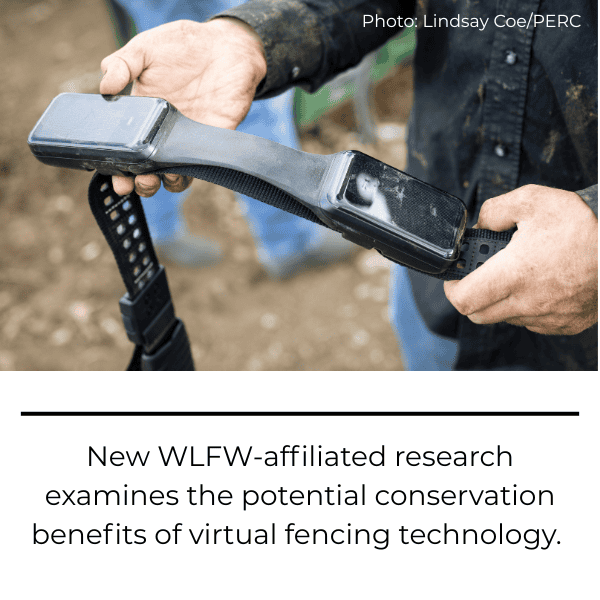
Opportunities, challenges, and benefits of virtual fencing for conservation
Across the globe, livestock grazing is one of the predominant land uses, covering 25% of the Earth’s terrestrial surface. Well-managed grazing not only provides food and fiber but is also compatible with the production of numerous ecosystem services like wildlife habitat, carbon sequestration, and more. Yet, grazing, especially in the western United States, relies on a legacy technology from the 1800’s – fencing.
Fencing is costly for people and animals. Livestock producers must first install fence infrastructure and then perpetually maintain it. Wildlife suffer mobility challenges, habitat fragmentation, and direct mortality from fence entanglements.
New research, co-authored by Working Lands for Wildlife’s Migratory Big Game science advisor, Jerod Merkle, examines how virtual fencing has the potential to revolutionize livestock grazing management, and especially conservation-focused livestock grazing systems.
Virtual fencing pairs Global Positioning System (GPS)-enabled collars worn by livestock with software-derived boundaries that contain livestock (or exclude them) to specific areas through collar-delivered stimulation signals.
Despite its promise for improving livestock management, few scientific studies have addressed virtual fencings’ potentials and limitations related to conservation.
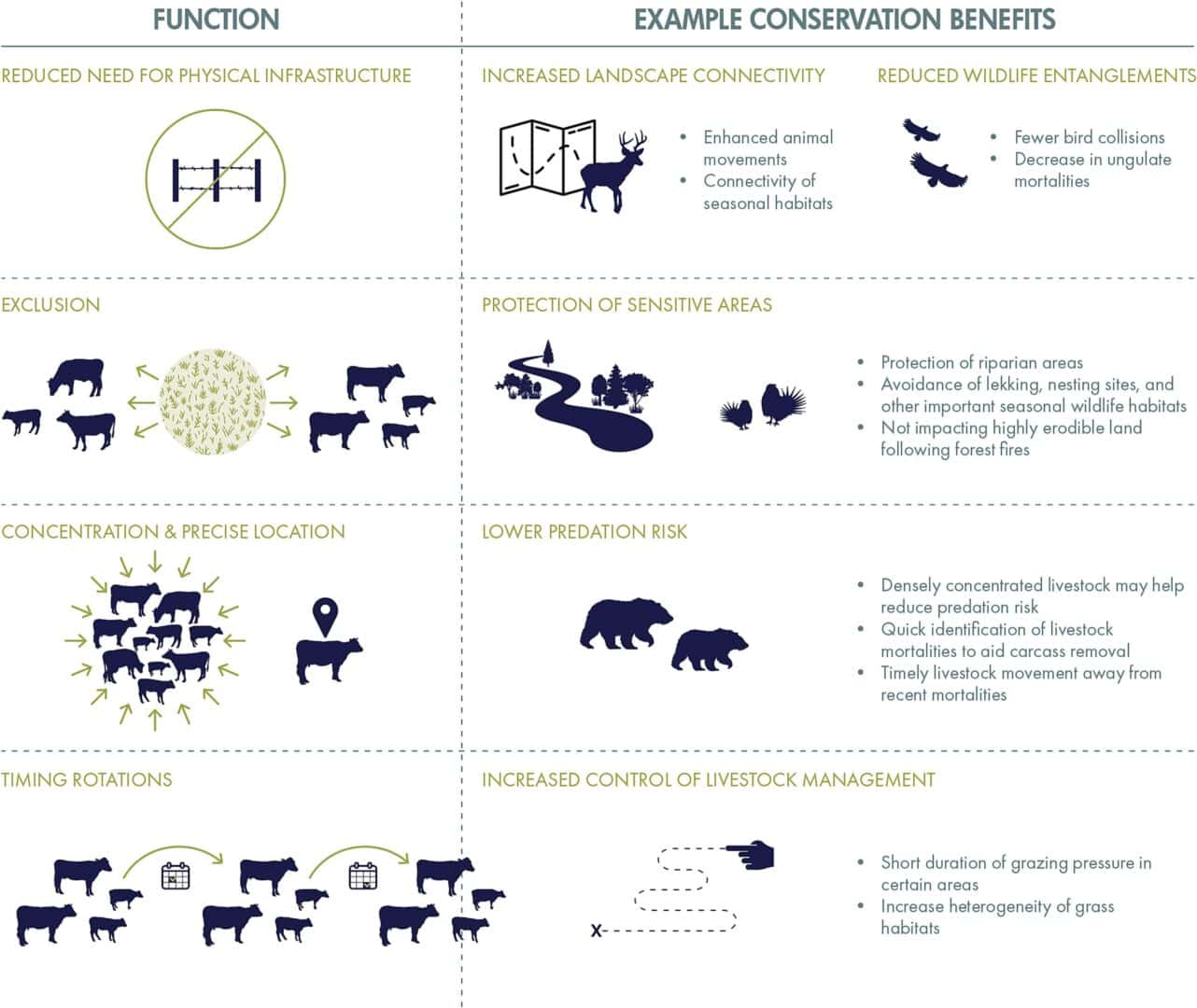
The researchers break potential benefits into four primary functions and commensurate conservation benefits, detailed in Figure 2 from the paper:
To fully realize the conservation benefits that virtual fencing may provide, the team suggests the following measures:
- Technical and financial support for producers looking to adopt virtual fencing systems and remove legacy physical fencing;
- Policy reforms that accelerate adoption of virtual fencing such as including virtual fencing in “wildlife-friendly” fencing modification programs that traditionally focus on physical fencing infrastructure;
- Innovative conservation agreements that leverage the flexibility of virtual fencing for specific conservation goals (e.g., excluding livestock from sensitive habitat for a short period of time);
- Building a base of evidence that virtual fencing can deliver potential conservation benefits while balancing operational needs.
While virtual fencing has the potential to generate real conservation benefits, there are challenges as well, according to the researchers. First, producers must be interested in conservation outcomes. Changing management strategies to gain such outcomes may come with other operational costs that create barriers for adoption. Second, the availability of environmental data that can be used to measure conservation outcomes is inconsistent from ranch to ranch or even pasture to pasture within a single ranch. Obtaining the baseline data and tracking conservation outcomes requires time, money, and likely partnerships, in addition to willing landowners.
From a livestock management systems perspective, the authors acknowledge that virtual fencing has upfront costs and requires learning new technologies and systems, but that these costs are often lower than traditional fencing, especially in the remote and rugged terrain that defines much of the American West. Further, labor costs associated with range riders, shepherds, and temporary fence construction and removal, can be reduced through the adoption of virtual fencing. For producers and livestock managers, increased operational efficiency and reduced operating costs are significant benefits.
Overall, the team found that virtual fencing has “[T]he potential to provide significant benefits to livestock producers, including greater flexibility to adjust grazing boundaries and pasture size, and to improve rangeland management through rotational grazing or other management practices.”
Achieving widespread adoption of virtual fencing has the potential to minimize impacts and maximize conservation goals for one of the Earth’s predominant land uses. This research highlights both the potential benefits and the challenges of such adoption. Partnerships between governmental agencies, conservation organizations, and livestock operations are critical to leveraging this opportunity.
WLFW’s Migratory Big Game Framework for Conservation Action, which identifies fencing as one of the primary threats to migratory big game, is a recent example of how these partnerships can create a shared vision that brings together livestock and conservation goals. Wyoming NRCS recently published a Virtual Fence Tech Note (Range Technical Note 4 – Virtual Fence), and when coupled with resources like the NRCS’s Biology Technical Note No. 93 – Improving Fence Passage for Migratory Big Game: Examples and Lessons Learned From Wyoming’s Migratory Big Game Partnership and the virtual fencing technology outlined in this paper, producers and conservation organizations have several tools to work together to reduce the impacts that physical fence infrastructure has on wildlife.
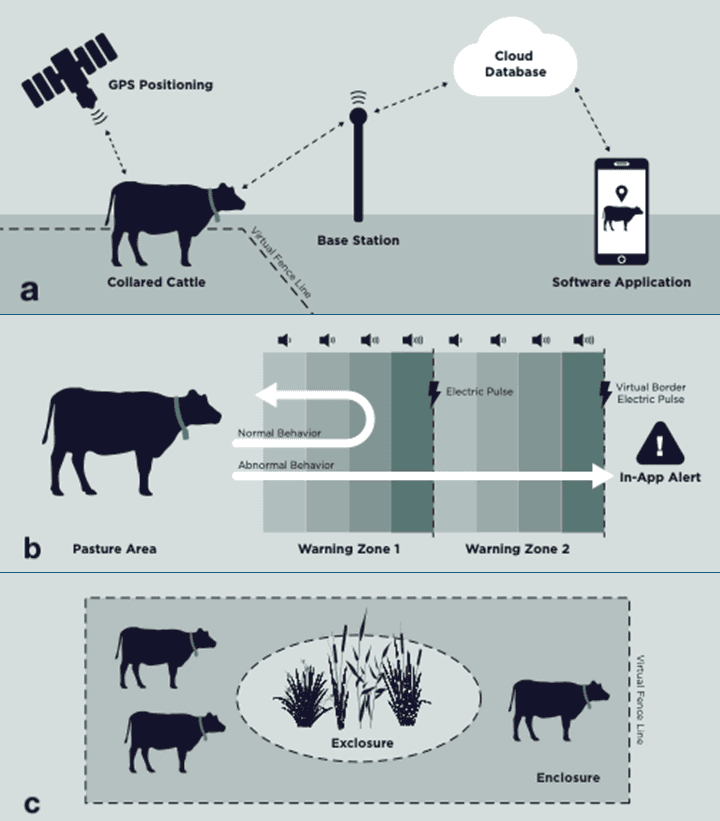
ADVANCING CONSERVATION THROUGH VIRTUAL LIVESTOCK FENCING
Abstract: Virtual fencing technology holds the potential to modernize and transform livestock management, with significant but still underexplored biodiversity conservation applications. The technology uses Global Positioning System-enabled collars on livestock and software-defined boundaries to provide a virtual alternative to traditional physical fencing, creating opportunities to remove or reduce physical fences. We identify four key functional attributes of virtual fencing that can be leveraged to achieve conservation goals: eliminating the barrier effects of physical fencing infrastructure that fragment landscapes, providing precise and temporally adaptable exclusion capabilities for protecting sensitive ecological areas, enabling targeted livestock concentration for invasive species control and predator conflict mitigation, and facilitating adaptive grazing rotations that promote habitat heterogeneity and vegetative health. Collectively, these functions address critical conservation challenges including restoration of landscape connectivity, protection of riparian habitat, maintaining wildlife corridors, and livestock-carnivore coexistence. Despite its promise as a conservation tool, adoption of virtual fencing still faces substantial barriers including technological limitations, learning curves for both operators and livestock, limited research on diverse livestock types, cost barriers, animal welfare concerns, data privacy issues, and the complexity of implementing virtual fencing specifically for conservation outcomes. Conservation organizations can accelerate virtual fencing deployment through strategic cost-sharing partnerships, incentive-based conservation agreements, and advocacy for supportive policy frameworks. Investment in interdisciplinary research will be essential for demonstrating effectiveness and addressing adoption barriers. Virtual fencing represents a transformative conservation tool with applications across diverse grazing contexts around the world and offers substantial opportunities to reconcile livestock production with biodiversity conservation and ecosystem restoration goals.
Citation: Drew E. Bennett, Travis Brammer, Jerod A. Merkle, Kurt T. Smith, Shawn Regan, Temple Stoellinger, Arthur Middleton, Kristin Barker, Jacob P. Hochard, Patrick E. Lendrum, Erin Welty, Craig Benjamin, Brian Yablonski, “Advancing conservation through virtual livestock fencing”, Biological Conservation, Volume 318, 2026, 111866, ISSN 0006-3207
Acknowledgements: The Alumbra Innovations Foundation, Knobloch Family Foundation, University of Wyoming, and USDA-NRCS provided financial support for this perspective.
Permanent URL: https://doi.org/10.1016/j.biocon.2026.111866