Publication Alert
Research Evaluates Indaziflam’s Efficacy In The Fight Against Invasive Annual Grasses
New research shows indaziflam’s efficacy for treating annual invasive grasses while boosting perennials, bare ground, and soil biocrusts.
How To Talk To Texans About Trees: Communications Resources For Woody Encroachment
September 29, 2026
Study shows less annual grass cover, more biodiversity, more soil biocrusts three-years post treatment
Invasive annual grasses (IAG), like cheatgrass, medusahead, and ventenata are the leading cause of ecological degradation in the sagebrush biome, responsible for 60% of the loss of core sagebrush areas annually, according to the Sagebrush Conservation Design.
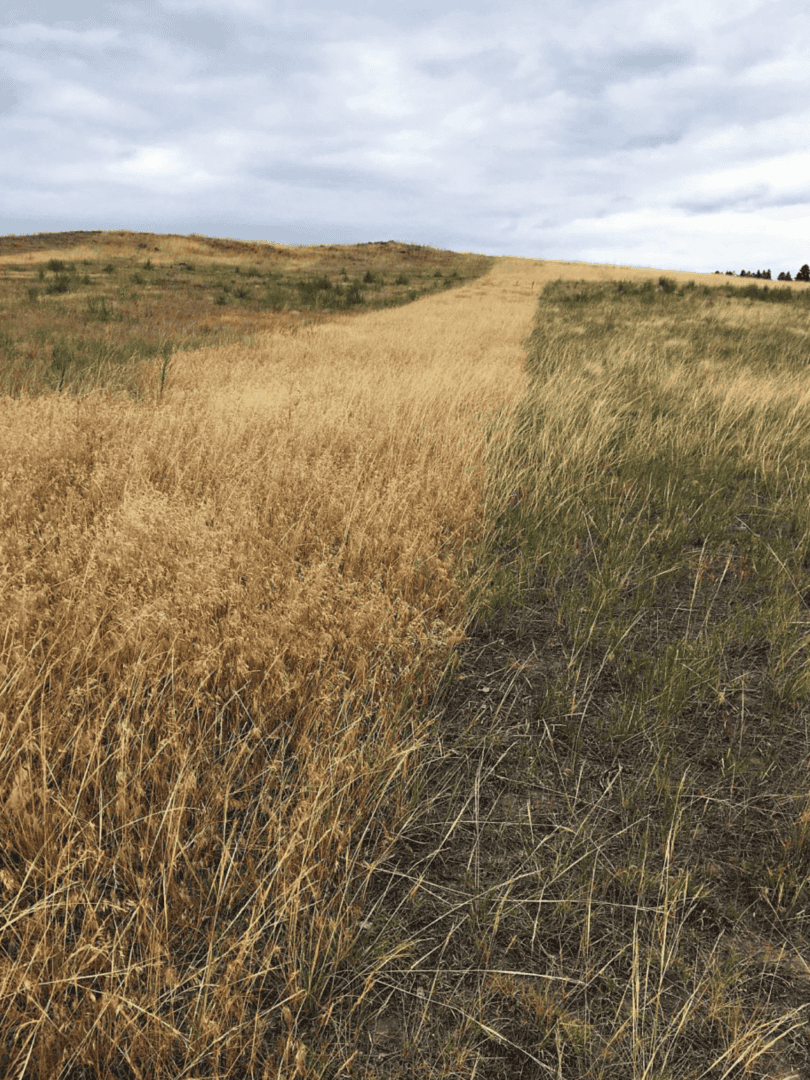
IAG green up early in the growing season, using up precious soil moisture and nutrients before native perennial plants can access the resources. They also dry out much earlier, creating highly flammable fine fuels that drive severe rangeland wildfire. After they burn, they quickly recolonize, leading to an ever-worsening annual grass-fire-annual grass-fire cycle. Because of their high silica content, they are unpalatable to game species like mule deer, which abandon otherwise suitable habitat when IAG cover approaches 20%.
These well-documented impacts make IAG management a key focus of rangeland professionals. However, treatment options are limited and success depends, in large part, on how perennial native plants can reestablish after IAG treatments.
A recently introduced pre-emergent herbicide called indaziflam, known commercially as Rejuvra, is becoming a key tool in the fight against IAG.
Kirk Davies, a researcher with the USDA Agricultural Research Service out of Burns, OR, recently published the results of a three-year study in eastern Oregon that examined indaziflam’s effects on native perennial vegetation, plant biodiversity, biological soil crusts, and fire probability.
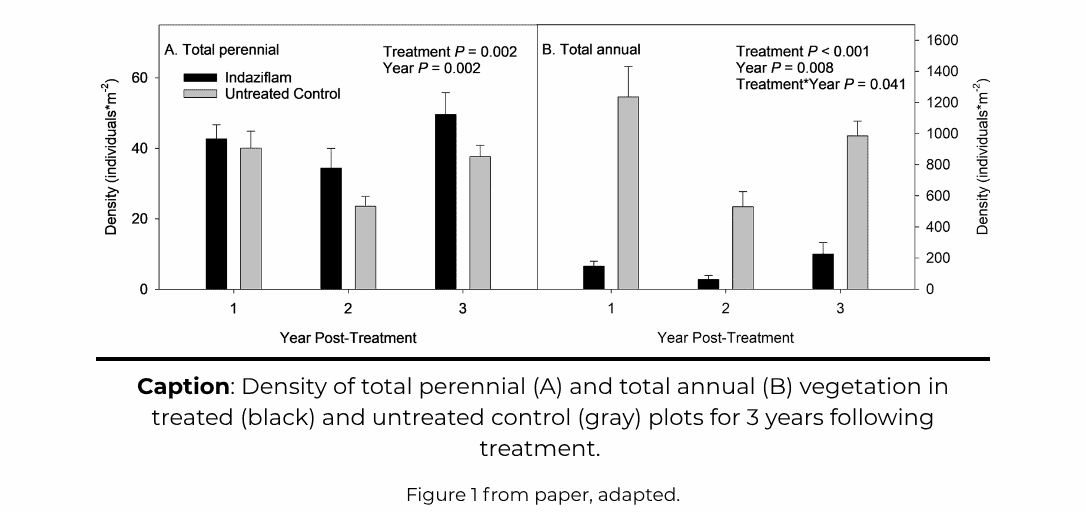
The research showed that indaziflam remained effective at controlling IAG throughout the three years of the study. This is a significant improvement over traditional pre-emergents like imazapic, which typically offer only 1–2 years of control before annuals return. A longer efficacy window provides more time for perennial vegetation to increase following treatment and reduces fire probability. It may also be more economical because follow-up treatments are less frequent.
The findings also show that indaziflam treatments successfully increased perennial grass/forb cover and density by reducing annual competition. However, this response is dependent on having a sufficient remnant native plant community present to respond, making targeted applications that defend core sagebrush areas where perennials are already present a key component of successful management.
Additionally, plant biodiversity (often measured by species evenness or relative abundance) increased in the study plots. After three years, biodiversity was 40% higher in the treated plots compared to the untreated, control plots. Plant species richness (the absolute count of individual species present) slightly dipped in the short term, likely the authors argue, due to a decrease in IAG and other annuals that were affected by indaziflam. However, the authors note that a short-term decrease in plant species richness is a worthy tradeoff for reduced IAG cover.
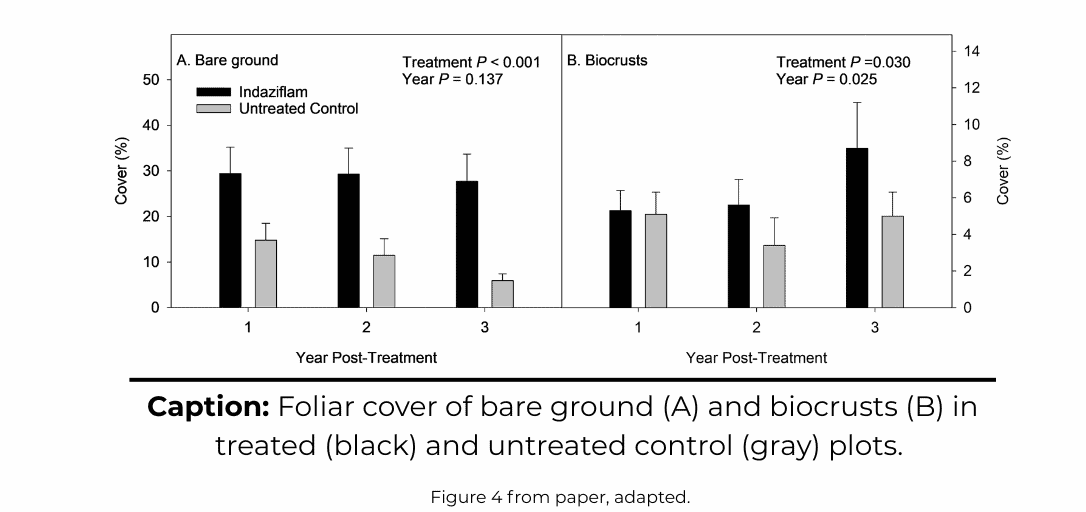
The study is the first to show that soil biocrusts – critical for water infiltration, soil moisture retention, fire prevention, reducing soil erosion, and preventing IAG establishment / re-establishment – increased following indaziflam applications. Three years after treatment, biocrusts averaged >8% cover, nearly double the cover in the untreated, control plots. Increased biocrust boosts soil water retention and reduces fire probability because of a reduction in fine fuels and litter that can serve as ignition sites and drive rangeland fires.
Overall, the research highlights indaziflam’s effectiveness at controlling IAG. Increased plant biodiversity benefits wildlife and livestock producers, increased soil biocrust and bare ground reduce wildfire risk, and longer efficacy compared to other pre-emergent herbicides translates to reduced management costs and more restored acreage.
Importantly, the authors note that targeted treatments in areas where perennial plants can rebound is key to successful restoration efforts. WLFW recently launched the Invasion Severity Index (ISI), a free, online mapping application, that helps conservation planners and managers better understand a site’s recovery potential following IAG treatments.
The ISI uses 10-meter data from the Rangeland Analysis Platform to evaluate annual grass cover, perennial grass and forb cover, and bare ground, producing an index of site recovery potential from 1-5. When combined with a defend the core strategy, the ISI can pinpoint locations where targeted application of indaziflam has the greatest chance of reducing IAG and increasing desired perennials.
EFFECTS OF INDAZIFLAM CONTROL OF ANNUAL GRASSES ON BIODIVERSITY, BIOCRUSTS, PERENNIAL VEGETATION, AND FIRE PROBABILITY
Abstract: Annual grass invasion in the western United States decreases biodiversity, biocrusts, and perennial vegetation and escalates the risk of large frequent wildfires. These effects degrade critical wildlife habitat and reduce quality livestock forage. In addition, altered fire regimes threaten life and property as well as greatly increase fire suppression costs. Controlling annual grasses to negate these negative impacts is a common management objective. Indaziflam, a more recently developed pre-emergent herbicide with longer soil activity, is increasingly used for annual grass control. More information on the effects of indaziflam on plant biodiversity, biocrusts, and perennial vegetation is needed because of contradictions in reported effects and inconclusive results. We investigated the effects of indaziflam application at 14 annual grass-invaded sites in bunchgrass rangelands in eastern Oregon. Ventenata ( Ventenata dubia (Leers) Coss.) and medusahead ( Taeniatherum caput-medusae (L.) Nevski) were the dominant annual grasses at the study sites. Indaziflam was applied at a rate of 73 g ai · _ha−1 in late August to early September in either 2019 or 2021. Plant community response to indaziflam application was measured for 3 yr post-treatment. Indaziflam effectively controlled invasive annual grasses for the duration of the study. Perennial vegetation cover and density increased substantially with indaziflam control of annual grasses. Plant biodiversity increased with indaziflam application, with it being 40% greater in the indaziflam treatment compared with the untreated control by the third year. Indaziflam control of annual grasses resulted in considerable increases in biocrusts and bare ground, and decreases in litter. The cumulative effects suggest that indaziflam increased plant community resistance to reinvasion by annual grasses and decreased wildfire probability. Indaziflam appears to be effective at controlling invasive annual grasses for multiple years and promoting perennial vegetation, biocrusts, and plant biodiversity.
Citation: Kirk W. Davies, Rory C. O’Connor, Stella M. Copeland, Jon D. Bates, “Effects of Indaziflam Control of Annual Grasses on Biodiversity, Biocrusts, Perennial Vegetation, and Fire Probability,” Rangeland Ecology & Management, Volume 109, 2026, Pages 1-9, ISSN 1550-7424
Acknowledgements: We are grateful to the numerous landowners for allowing us to conduct this research on their properties. We appreciate Christie Guetling and all the summer technicians for collecting and entering data for this experiment. We also thank the staff at the Eastern Oregon Agricultural Center that assisted with setting up the experiments. Thoughtful reviews by Dr. Cameron Duquette of earlier versions of this manuscript substantially improved the final version.
Permanent URL: https://doi.org/10.1016/j.rama.2026.07.001