Upland Bird Leks: The Wildest Dance Floors On Earth
Each spring, prairie chickens, sharp-tailed and sage grouse convene on North America’s grasslands and sagebrush plains to strut their stuff.

Invasion Severity Index
April 10, 2026Publication Alert: The Invasion Severity Index
April 16, 2026
Grouse And Prairie Chickens’ Spring Mating Ritual
At sunrise on lovely spring mornings, certain pockets of prairie and sagebrush plains transform into some of the wildest dance floors on Earth.
Upland birds gather on small patches of open ground across North America’s sagebrush-steppe and Great Plains grasslands. Male prairie-chickens boom, sage grouse pop, and sharp-tailed grouse spin.
Why the elaborate dance routines? To capture the attention of females in the audience who are looking to choose a mate.
Mating season for upland birds takes place from late February through early May, depending on weather conditions and elevation. For those fortunate enough to witness them, these dancing showdowns are among the most exciting wildlife spectacles in the American West — and many of them take place on private working lands stewarded by livestock ranchers.
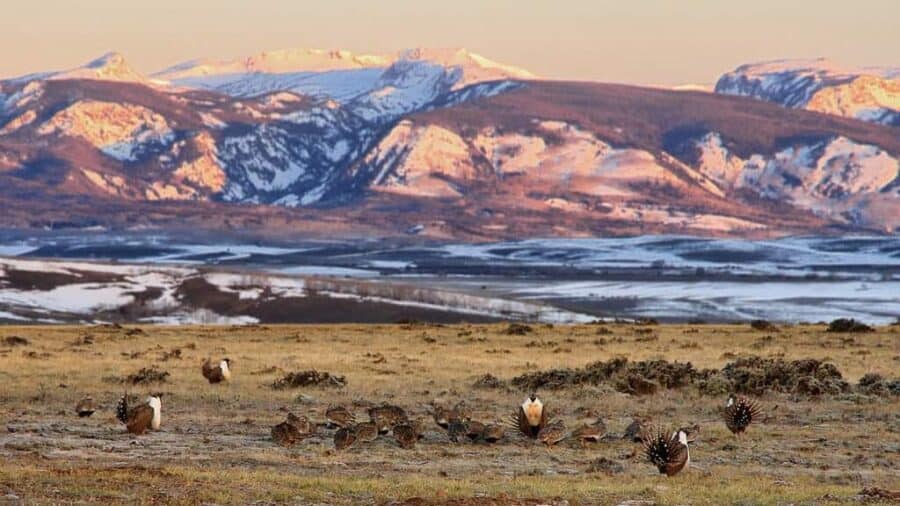
Leks Are A Natural Stage
The mating grounds of upland birds are called leks—an outdoor stage where males advertise their prowess for females.
Leks are typically open areas where the males’ displays are easily visible. This includes hilltops, meadows, or patches of ground with sparse vegetation.
These breeding arenas may serve upland birds for decades. Several generations of birds will often return to the same lekking site each spring.
Ladies Choice On A Lek
Only male birds, called cocks, perform the intricate steps, loud sounds, and competitive strutting. But it’s always ladies’ choice at the lek.
The hens fly in at dawn to watch the performance, then select the males with the most elaborate plumage, unusual sounds, and athletic ability. Once they mate, hens choose a nest site near the lek to lay eggs and the males’ role is over. Females raise their broods alone.
Not all males get lucky. A single dominant male may mate with the majority of females on a lek.
Sage Grouse: Beatboxers Of The Sagebrush

Amidst the frosty spring sagebrush, greater sage-grouse strut their stuff at dawn. Each cock spreads its spiky tail like a fan, drops its wings, and inflates two round yellow air sacs on his chest. The air sacs expand and collapse in rapid sequence, producing a series of pops, whistles, and swishing sounds that carry across the range.
Males need stamina—they repeat this tail-fanning, chest-popping display for a few hours before and after sunrise.
While displaying, male sage grouse also establish tiny territories on the lek, then fight to defend them. Dominant birds usually occupy the center of the arena, where females tend to congregate. A single, successful male might mate dozens of times in one morning while less dominant males never mate at all.
Prairie Chickens: Boomers Of The Plains
At first light on the prairies of America’s Great Plains, greater and lesser prairie-chickens assemble on “booming grounds”, another name for leks. The name comes from the birds’ deep booming calls, which resonate when the males inflate bright air sacs on their necks.
Between calls, prairie chicken cocks put on a show for females. They drop their wings low, raise their tails, thrust their head forward, and rapidly stomp their feet. The movements are accompanied by hissing sounds and short bursts of flight as males confront rivals.
Greater prairie-chickens have orange air sacs and a deeper boom. Lesser prairie-chickens have red air sacs and produce a higher-pitched, cackling boom—they also have a faster-paced dance.
Booming grounds were culturally important to Indigenous peoples in the Great Plains. The displays at prairie chicken leks inspired colorful dances among certain Tribes.

Sharp-Tailed Grouse: Tap Dancers Of The West

Along open edges of forests or shrublands, male sharp-tailed grouse gather in groups for a fast-paced foot-stamping routine. They inflate beautiful purple air sacs, rattle flight feathers, then step up to 20 times per second while pivoting in tight circles. This rapid-fire stomping creates a purring sound that accompanies the males’ movements.
As with other upland birds, it’s an all-out fight for the females’ favor. Competing males leap toward one another, pecking, wing-beating, and chest-bumping as they battle for the most desirable spot on the lek. Females often visit several leks before selecting a mate in late April or early May, evaluating the males’ energy, plumage, and dominance.
Six subspecies of sharp-tailed grouse perform on rangelands in the northern part of the Midwest and West, as well as in Alaska and several Canadian provinces.
Tips for Seeing Upland Birds Dance
On public land in some states, it’s possible to watch the intimate mating rituals of upland birds. You might also see other wildlife wandering across the range at dawn, like mule deer, pronghorn, elk or eagles.
It’s very important to keep your distance at leks so you don’t disturb the birds or damage their habitat. Here are a few tips for respectful wildlife viewing:
- Wait until late April when most of the breeding has taken place, but males are still actively strutting.
- Arrive at the lek at least one hour before sunrise while it’s still dark.
- Don’t drive on or near the lek and park away from the edge of the lek.
- Turn off your engine and lights, then stay in your vehicle.
- Use binoculars and spotting scopes to observe birds.
- Don’t make loud noises or sudden movements.
- Don’t leave the lek site until the birds do.
- Keep your pets in the vehicle or, better yet, leave them at home.
- Don’t trespass on private land.
- Postpone your visit if roads are muddy.
- Reach out to your state fish and game department or to local bird watching groups for information on public viewing sites in your area.